

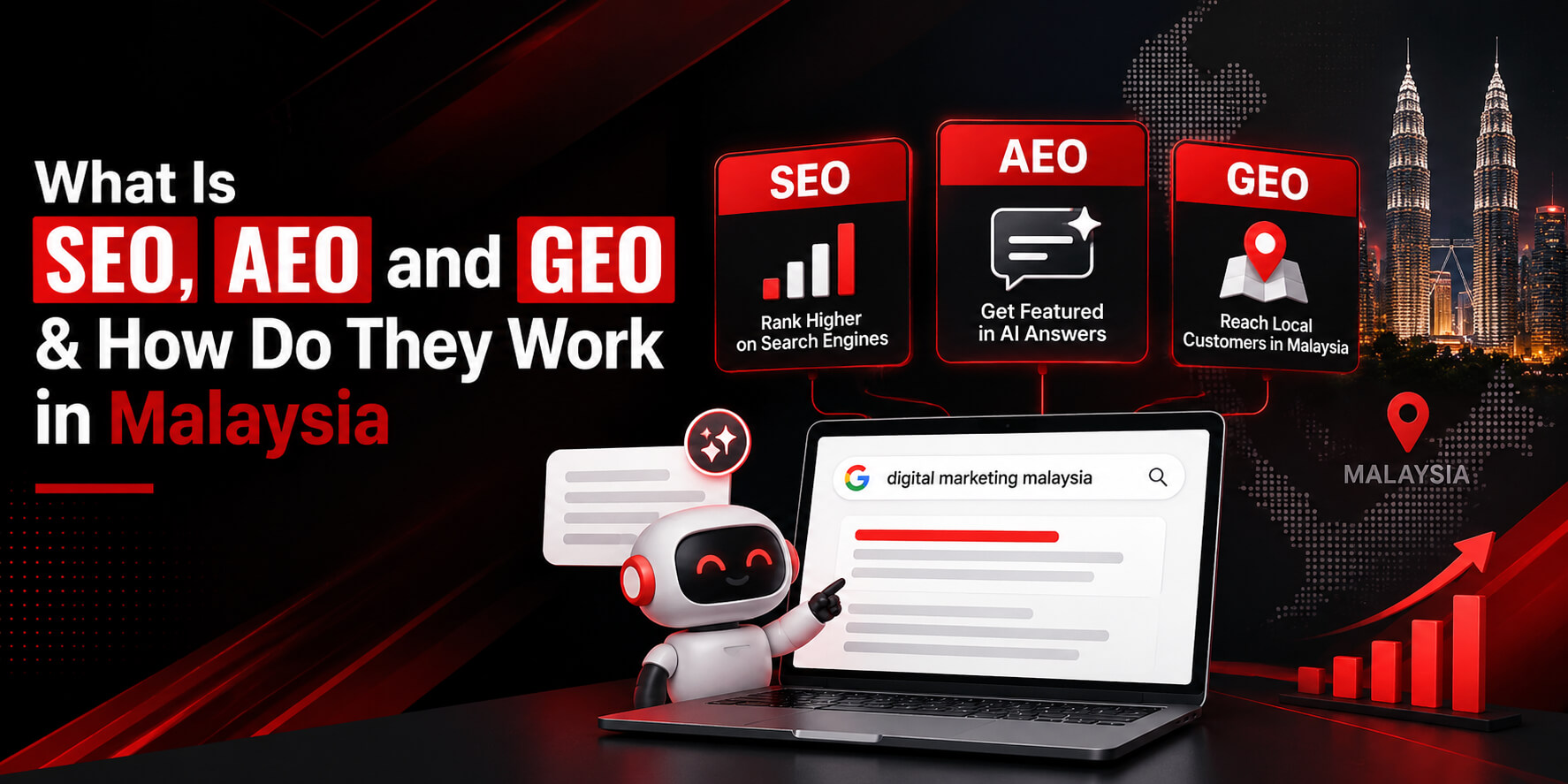
What Is SEO, AEO and GEO & How Do They Work in Malaysia
SEO gets your website ranked in Google’s results, AEO gets your content picked as the direct answer, and GEO gets your brand cited inside AI tools like ChatGPT, Gemini and Google’s AI Mode. In Malaysia you need all three, because Google handles over 92% of searches and its AI answers now appear in both English and Bahasa Malaysia.
The short version:
- SEO (Search Engine Optimisation): making your pages easy for search engines to find, understand and rank, so people click through to your site.
- AEO (Answer Engine Optimisation): structuring content so it is chosen as the answer itself — a featured snippet, a “People also ask” box, a voice assistant reply or an AI Overview.
- GEO (Generative Engine Optimisation): making your brand and content trustworthy and clear enough that generative AI tools mention, summarise and link to you when they write a response.
They are not three separate strategies. AEO and GEO sit on top of SEO: if search engines cannot crawl and trust your site, AI systems will not quote it either. This guide explains how each works, what is different about search in Malaysia, and the practical steps a Malaysian business can take.
What is SEO and how does it work?
SEO is the work of making your website the best result for a search, so Google shows it near the top and people click. It is still the foundation, because every AI answer feature Google offers pulls from pages it has already crawled and indexed.
Google works in three stages:
- Crawling: Googlebot follows links and reads your sitemap to discover pages. If a page is blocked in robots.txt, hidden behind a login or not linked from anywhere, it may never be found.
- Indexing: Google reads the page’s text, images and structured data, works out what it is about and stores it. Duplicate or thin pages are often grouped together or left out.
- Ranking: When someone searches, Google orders the indexed pages by relevance, quality, trust and page experience — including how fast and stable the page is on a phone.
SEO work maps to those stages:
- Technical SEO: It keeps crawling and indexing clean: an XML sitemap, a sensible robots.txt, HTTPS, fast loading, no broken links, a mobile-friendly layout.
- On-page SEO: It makes each page clearly about one topic: a unique title and meta description, logical headings, descriptive image alt text and helpful internal links.
- Content: Website content answers what the searcher actually wants, written for people first. Google calls this “helpful, reliable, people-first content” and rewards experience, expertise, authoritativeness and trust (E-E-A-T).
- Off-page SEO: It builds trust from outside: links from relevant, reputable sites, press mentions and genuine reviews.
A Malaysian example: a physiotherapy clinic in Petaling Jaya wants to rank for “physio for back pain PJ”. SEO means a dedicated service page for back pain, the clinic’s address and opening hours on the page, a fast mobile layout, and links from local health directories and community sites.
What is AEO and how does it work?
AEO is about being the answer, not just a link. More searches now end on the results page itself — the user reads a featured snippet, an AI Overview or hears a voice reply, and may never scroll to the blue links.
Answer engines include:
- Featured snippets: the boxed answer at the top of Google results.
- “People also ask”: expandable related questions.
- AI Overviews: Google’s AI-written summary with source links, available in Malaysia.
- Voice assistants: Google Assistant, Siri and Alexa reading out one answer.
An answer engine looks for a passage that answers the question directly, clearly and from a trusted page. So AEO is mostly about how you write and structure content:
- Phrase headings as the questions people really ask (“How much does a website cost in Malaysia?”).
- Answer in the first one or two sentences under the heading, then add detail.
- Use lists for steps, tables for comparisons and prices, and short paragraphs.
- Add an FAQ section for related questions, and keep facts like prices, dates and opening hours current.
- Use structured data (schema markup) that matches what is visible on the page, such as LocalBusiness, Product or Article.
Google states there are no extra requirements or special markup needed to appear in AI Overviews or AI Mode. A page only has to be indexed and eligible for a snippet. In practice, AEO is good SEO with answer-first writing.
What is GEO and how does it work?
GEO is about being mentioned and cited when an AI tool writes an answer. When someone asks ChatGPT, Gemini, Perplexity, Claude or Google’s AI Mode “Which accounting firms in Penang are good for SMEs?”, the tool writes a response and names a few businesses. GEO aims to make yours one of them.
Generative engines build answers in two ways:
- From what the model learned in training: A broad picture of brands and topics from public web text.
- From live retrieval: Searching the web while answering, reading several pages and citing them. Google’s AI Mode, for example, uses a “query fan-out” technique that splits a question into subtopics and searches each one.
That means GEO depends on two things: being retrievable (crawlable, indexed, ranking) and being consistently described across the web. AI tools trust a claim more when many independent sources agree.
What helps:
- Clear entity information: Your business name, what you do, where you operate and who runs it, stated the same way on your site, Google Business Profile, social profiles and directories.
- Citable facts: Original data, specific prices, process details and named experts give AI tools something concrete to quote.
- Third-party mentions: Coverage in Malaysian media, industry associations, review sites and forums like Lowyat.net shapes how AI describes you.
- Self-contained passages: Sections that make sense on their own are easier for a model to lift and cite.
- Crawler access: Check that robots.txt and your CDN do not block the AI search crawlers you want to appear in. Blocking Google-Extended limits use in Gemini training but does not remove you from AI Overviews, which Googlebot controls (Google).
GEO is the newest of the three and the least measurable. Treat it as an extension of brand building and SEO, and be wary of anyone selling guaranteed AI rankings.
SEO vs AEO vs GEO at a glance
The three overlap heavily; the difference is where your content ends up and how success is measured.
| SEO | AEO | GEO | |
| Goal | Rank and earn clicks | Be the direct answer | Be mentioned and cited by AI |
| Where it shows | Google’s ranked results | Featured snippets, People also ask, AI Overviews, voice | ChatGPT, Gemini, Perplexity, Claude, Google AI Mode |
| User behaviour | Clicks through to your site | Reads the answer, may or may not click | Reads an AI-written reply, clicks a cited source if needed |
| Main levers | Technical health, keywords, content, backlinks | Question headings, answer-first writing, lists, tables, schema | Entity consistency, citable facts, third-party mentions, crawler access |
| How you measure | Rankings, organic clicks, conversions | Snippet ownership, impressions, branded searches | Brand mentions and citations in AI answers, referral traffic from AI tools |
| Maturity | Established | Established | Emerging, few reliable tools |
How SEO, AEO and GEO work in Malaysia
Malaysia is an almost fully online, Google-first, multilingual market and Google’s AI answers are already live here in both English and Malay.
| Fact | Figure | Source |
| Internet users (Oct 2025) | 35.4 million, about 98% of the population | DataReportal Digital 2026 |
| Active social media identities (Oct 2025) | 30.7 million | DataReportal Digital 2026 |
| Google share of search (Jul 2026) | 92.5% (Bing 4.7%, Yahoo 1.8%) | Statcounter |
| AI Overviews | Available in Malaysia, with Malay language support | Google Help |
| AI Mode | Launched in English in Aug 2025; Bahasa Malaysia added from Oct 2025 | Pokde, NextRift |
What that means in practice:
- Optimise for Google first. With over nine in ten searches on Google, Google’s guidelines, Search Console and Google Business Profile matter far more than any other engine. Bing is still worth a quick setup, because some AI assistants draw on its index.
- Plan for several languages. Malaysians search in English, Bahasa Malaysia, Chinese and Tamil, and often mix them (“kedai repair aircond near me”). Research keywords in each language your customers use, and create properly written pages per language rather than machine-translated copies. Use hreflang tags (for example ms-MY, en-MY, zh-MY) so Google shows the right version.
- Win local and mobile searches. “Near me” searches, Google Maps and Waze drive foot traffic. A complete, verified Google Business Profile with accurate hours, photos and reviews feeds Maps, local results and AI answers alike.
- Expect AI answers on informational queries. Questions like “how to renew road tax online” or “best area to stay in KL for families” often trigger an AI Overview. Pages that answer clearly, with local specifics, are the ones cited.
- Remember search happens beyond Google. Shoppers search directly on Shopee, Lazada and TikTok, and younger users discover brands on social video. Your marketplace listings and social content are part of how AI tools and people learn about your brand.
- Respect local rules. Collect personal data in line with Malaysia’s Personal Data Protection Act (PDPA), and keep advertising claims accurate. Content in regulated or prohibited categories will not be helped by any search strategy.
A step-by-step playbook for Malaysian businesses
Work in this order: fix the foundations, then write answer-first content, then build the reputation AI tools rely on. Each step supports all three disciplines.
1. Fix the technical foundation (weeks 1–2)
- Verify your site in Google Search Console and Bing Webmaster Tools.
- Publish a working XML sitemap, submit it, and list it in robots.txt.
- Check robots.txt and your CDN (for example Cloudflare’s bot settings) are not blocking Googlebot, Bingbot or the AI search crawlers you want.
- Fix broken links, 404 pages and redirect chains.
- Make pages fast on mid-range phones: compress images, use WebP, set image width and height to stop layout shift, and cut unused scripts.
- Give every page a unique title and meta description.
2. Map what Malaysians actually search (weeks 2–3)
- List the questions customers ask your staff, on WhatsApp and in reviews.
- Research keywords in each language you serve, including mixed-language phrasing.
- Group keywords by intent: learning (“what is”), comparing (“best”, “vs”), and buying (“price”, “near me”).
3. Create answer-first, people-first content (ongoing)
- One clear page per service, product or location.
- Question-style headings with a direct answer in the first sentence.
- Malaysian specifics: prices in RM, local regulations, areas served, real photos and examples.
- Show who wrote it and why they know: author names, qualifications, years of experience.
- Add FAQ sections and accurate schema markup (LocalBusiness, Product, Article, FAQ where relevant).
- Link related pages to each other so users and crawlers can follow the topic.
4. Own your local presence (weeks 2–4, then monthly)
- Complete and verify Google Business Profile: category, hours, services, photos, posts.
- Keep name, address and phone identical across your site, Maps, Waze, Facebook and directories.
- Ask happy customers for reviews and reply to every review, good or bad.
5. Build authority and AI visibility (ongoing)
- Earn links and mentions from relevant Malaysian sources: trade associations, local news, partner businesses, universities, event sponsorships.
- Publish something worth citing: a price survey, a local guide, original research.
- Keep your brand description consistent on your About page, LinkedIn, social profiles and directories.
- Avoid paid link schemes and auto-generated links; they add risk, not authority.
Common mistakes Malaysian websites make
Most underperforming Malaysian sites fail on basics, not on advanced AI tactics.
- Keyword stuffing. Repeating the brand name or “best X in Malaysia” in every sentence reads badly and signals low quality to Google and AI tools.
- Duplicate metadata. Dozens of pages sharing one meta description, often across language versions, so none stands out.
- Heavy, unstable pages. Large uncompressed banners and sliders that load slowly on mobile data and shift the layout as they appear.
- Missing or broken sitemaps. A sitemap that returns a 404 makes it harder for Google to find new pages.
- Machine-translated Malay or Chinese pages. Awkward translations hurt trust and rarely rank.
- Buying cheap backlinks. Bulk directory and auto-generated links do little and can trigger spam penalties.
- Chasing “GEO hacks”. There is no special file or markup that forces AI tools to cite you. Google confirms you do not need AI text files or special schema.
- No tracking. Without conversion tracking for enquiries, WhatsApp clicks or sales, you cannot tell which efforts pay off.
How to measure results
Measure business outcomes first, then the search signals that lead to them. SEO usually takes three to six months to show meaningful movement for a new or weak site.
| Discipline | What to track | Where |
| SEO | Indexed pages, impressions, clicks, average position, organic conversions | Google Search Console, Google Analytics 4 |
| AEO | Queries where you appear as a featured snippet or in AI Overviews, growth in branded searches | Search Console (AI features are counted in the Web performance report), manual checks |
| GEO | How often AI tools mention or cite your brand for your key questions, referral visits from chatgpt.com, perplexity.ai and gemini.google.com | Monthly manual prompts in each tool, GA4 referral report, AI visibility tools |
| Business | Enquiries, WhatsApp clicks, calls, bookings, sales from organic and AI referrals | GA4 conversions, CRM |
For GEO, keep a fixed list of 10–20 questions your customers would ask, run them each month in ChatGPT, Gemini, Perplexity and Google AI Mode, and record whether you are mentioned and which sources are cited. The cited sources show you where to earn coverage next.
Frequently asked questions
Is SEO dead now that AI answers exist?
No. Google’s AI Overviews and AI Mode cite pages from its normal index, and Google says standard SEO best practices are what make a page eligible. Weak SEO means weak AEO and GEO.
What is the difference between AEO and GEO?
AEO targets answer boxes inside search engines, such as featured snippets and AI Overviews. GEO targets AI assistants and chat tools that write full responses, such as ChatGPT, Gemini and Perplexity. The tactics overlap; GEO leans more on brand reputation across the web.
Do I need separate content in Bahasa Malaysia?
If your customers search in Malay, yes. Google and its AI features support Malay, and a well-written Malay page can rank for queries an English page will not.
How long does SEO take to work in Malaysia?
Technical fixes can show results in weeks. Ranking for competitive terms typically takes three to six months or longer, depending on your site’s starting authority and the competition.
Can I pay to appear in AI Overviews or ChatGPT answers?
Organic citations cannot be bought. Google does run ads around and within some AI experiences, but those are labelled ads, separate from AEO and GEO.
Should I block AI crawlers?
It is a trade-off. Blocking AI search crawlers can keep your content out of those tools’ answers. Blocking training-only crawlers such as Google-Extended or GPTBot limits model training but does not affect Google Search. Decide based on whether you want visibility in each tool.
Do I need an agency?
A small business can handle the basics Search Console, Business Profile, clear service pages, and reviews. An experienced specialist helps with technical audits, multilingual sites and competitive markets. Avoid anyone promising guaranteed number-one rankings.
Final Thoughts
SEO makes you findable, AEO makes you the answer, and GEO makes you the brand AI recommends — and in Malaysia all three run mainly through Google. Start with a clean, fast, mobile-friendly site, write answer-first content in the languages your customers use, keep your local listings accurate, and earn genuine mentions from trusted Malaysian sources. That combination serves people first, which is exactly what both search engines and AI tools are built to reward.
Sources
- https://datareportal.com/reports/digital-2026-malaysia
- https://gs.statcounter.com/search-engine-market-share/all/malaysia
- https://developers.google.com/search/docs/appearance/ai-features
- https://support.google.com/websearch/answer/14901683?hl=en
- https://support.google.com/websearch/answer/16011537?hl=en
- https://pokde.net/system/software/ai/google-ai-mode-malaysia
- https://nextrift.com/202541841/
Recent Posts

October 23, 2026
How Long Does SEO Take to Show Results in Malaysia?

October 22, 2026
What Is the Difference Between SEO and Google Ads?

October 14, 2026

Leave a comment